"How was school ?" and other dinnertime conversation
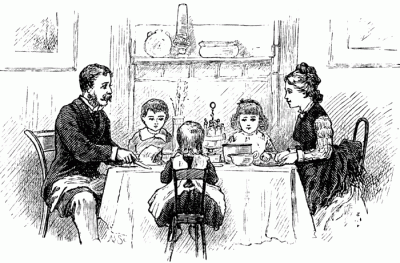

As an adult, dinnertime continued to be an important part of our day. While our son was growing up, my wife, son, and I sat down to eat together each morning for breakfast and each evening for dinner. Whether it was a carefully prepared home-cooked meal or simply pizza or other take-out food, the important thing was we sat down as a family—regularly—and enjoyed a meal and pleasant conversation. It was a time to talk about the day’s events, our plans, our hopes, our dreams. It was an important time to stay in touch with each other’s lives. To this day, our son still smiles (he’s 34 now) as I say slowly with a raised eyebrow, “How was school?”, a question often asked at the dinner table. Because I was a teacher in the same school district, he was never quite sure whether or not I knew something about what might have happened that day. He was an incredibly honest child who told the truth. But like any young child, he’d rather avoid talking about any trouble he may have gotten into at school if possible. When I’d ask the question, he was never quite sure if I already knew! But our conversations weren't limited to school. We talked about our interests, activities, friends, joys, hopes, and disappointments.
Although it always just seemed like the right thing to do, as it turns out, eating dinner together was good for us! Researchers have shown time and again that family dinnertime is an important predictor of some very positive social, psychological, and emotional outcomes. Research show us that children who regularly sit down with family at dinnertime:
- Are typically healthier
- Eat better diets
- Are happier
- Have better communication skills
- Are often closer to their parents and confide more
- Parents are usually more aware of subtle changes in behavior that could signal growing problems
- Preschoolers who eat together with family develop better language skills
- Quality of mealtime conversation is a strong predictor of children’s language and literacy development.
Our dinner table conversations have fostered a life time of communication. Even though he now lives 2 ½ hours away, my son and I still have father/son talks on the phone each day. Now isn't that worth having meals together while their young?
You should also read:

Discipline: Yes, No, and Other Choices
Recently I attended an event with a group of friends that was family-oriented--children, parents, grandparents alike. About 20 of us gathered for a picnic where each family contributed the usual potato salad, cheese dip, chips, crackers, along with some more substantive hot dogs, hamburgers, etc. We all…
Continue reading...
Choosing a good school...
by Steven A. Melnick -- For people who already rent or own a home, the choice of which elementary school their child(ren) will attend is determined largely by geography. School districts typically have defined attendance zones for each of their buildings. But for those parents…
Continue reading...
Archived Comments
Mark — November 22, 2010
To be honest, I could always tell whether Dad had something on me from the way in which he asked, "How was school?". If it was said in context, as in "So, how was school? Did you have fun? What did you do?", then I knew I was safe. Just chit-chat.
But if it was an unqualified, out-of-the-blue, "How was school?", then I knew he had something on me. I can still feel the pit grow in my stomach when I think about it.
For reasons that to this day elude me, I informed him of his "tell" around sixth or seventh grade. Especially going into high school, it muddied the waters of "how much does he know?" significantly.
--Mark
Katie Meyers — November 22, 2010
A teacher friend of mine gave me a tip to get the "How was school today?" conversation past the one-word answers of "good" or "fine". She recommended using the phrase, "Tell me three things that happened to you today at school". It takes the conversation alot farther.
Steven Melnick — November 22, 2010
I like it. Anything that gets them talking is a good thing.
Panna — November 29, 2010
Mark - your comment makes me smile because when I ask that same question a particular way, Jacob asks, "Did my teacher email you?"
Panna — December 2, 2010
Excellent tip, thanks for sharing. Last night we found out that my son had spent some time writing a donor a thank you letter, that his class had contributed a total of 95 cans of food to the food bank, and that he had gotten a perfect grade on his math quiz. If I had just asked him how school was, he would have happily told me about his math grade but we would have missed out on all the other good stuff. Thanks again for this!